
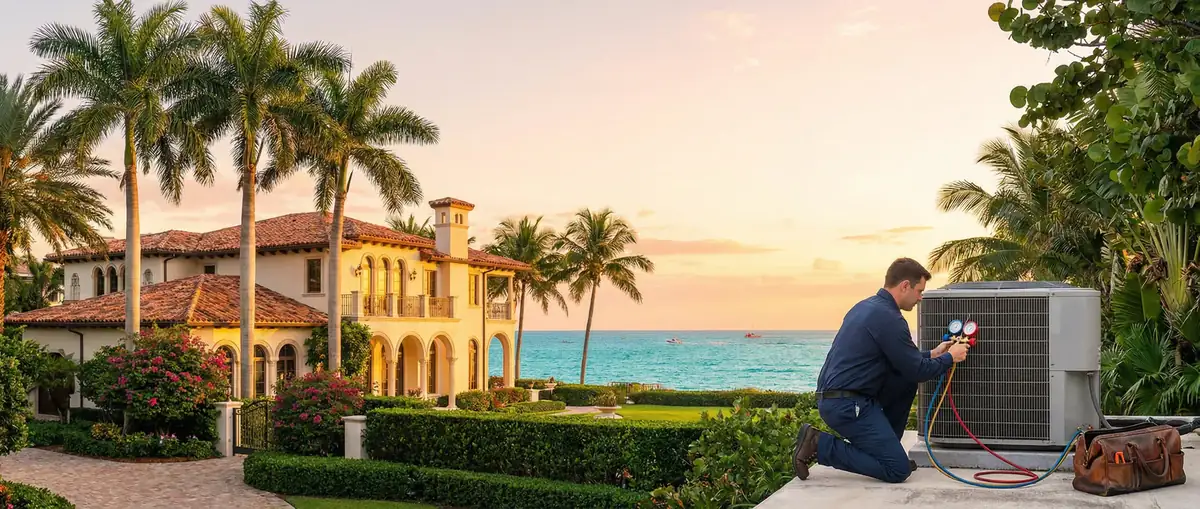
Your AC is running, but the house is not getting any cooler. It is one of the most frustrating problems South Florida homeowners face, especially during the summer months when indoor temperatures can climb into the 80s within hours. Before you panic, understand that many of the most common causes have straightforward solutions — some you can even fix yourself.
1. Dirty or Clogged Air Filter
This is the single most common reason an AC system stops cooling effectively. A dirty filter restricts airflow over the evaporator coil, reducing the system's ability to absorb heat from your home. In South Florida's dusty, humid environment, filters can clog in as little as 30 days.
DIY fix: Check your filter and replace it if it looks gray or clogged. Use a MERV 8-11 rated filter for the best balance of filtration and airflow. Set a monthly reminder to check it.
2. Thermostat Issues
Sometimes the problem is not the AC itself but the thermostat. Dead batteries, incorrect settings, or a thermostat placed in direct sunlight can all cause your system to behave unexpectedly. If your thermostat is set to "ON" instead of "AUTO," the fan runs continuously even when the compressor is off, blowing warm air through the vents.
DIY fix: Replace batteries, ensure the thermostat is set to "COOL" and "AUTO," and verify the set temperature is below the current room temperature. If the display is blank or unresponsive, you may need a thermostat replacement.
3. Frozen Evaporator Coil
If you notice ice forming on the indoor unit or refrigerant lines, your evaporator coil has frozen. This is usually caused by restricted airflow (dirty filter, closed vents) or low refrigerant levels. A frozen coil cannot absorb heat, so your AC blows lukewarm air.
What to do: Turn the system to "FAN ONLY" for 2-3 hours to let the ice melt. Check and replace the filter. If the coil freezes again after restarting, call a technician — you likely have a refrigerant leak.
4. Low Refrigerant (Refrigerant Leak)
Refrigerant is the chemical that absorbs heat from your indoor air. If your system is low on refrigerant, it cannot cool effectively. Unlike a car, an AC system does not "use up" refrigerant — if levels are low, there is a leak somewhere in the system that needs to be found and repaired.
Signs of low refrigerant: Warm air from vents, ice on the refrigerant lines, hissing or bubbling sounds near the indoor unit, higher-than-normal electric bills.
Professional repair required. Refrigerant handling requires EPA certification. A technician will locate the leak, repair it, and recharge the system. Typical cost: $350 to $1,200.
5. Dirty Condenser Coil (Outdoor Unit)
The outdoor condenser unit releases the heat absorbed from your home. If the condenser coils are covered in dirt, grass clippings, or debris, they cannot release heat efficiently, and your system's cooling capacity drops significantly.
DIY fix: Turn off the system, then gently rinse the outdoor unit's fins with a garden hose (never use a pressure washer). Clear any vegetation within 2 feet of the unit. Schedule professional coil cleaning annually.
6. Clogged Condensate Drain Line
Your AC removes humidity from the air, and that moisture drains through a condensate line. In South Florida's humid climate, algae and mold can clog this line quickly. Many modern systems have a safety float switch that shuts down the AC when the drain is clogged to prevent water damage.
DIY fix: Locate the drain line (usually a PVC pipe near the outdoor unit) and flush it with a cup of white vinegar or diluted bleach monthly. If the system has already shut down, you may need a technician to clear the blockage with a wet/dry vacuum.
7. Failing Capacitor
Capacitors are small electrical components that help start and run the compressor and fan motors. When a capacitor fails, the motor it supports may not start at all, or it may run weakly. You might hear a clicking or humming sound from the outdoor unit without the fan spinning.
Professional repair required. Capacitors store electrical charge and can be dangerous to handle. This is one of the most common and affordable AC repairs — typically $75 to $250 including parts and labor.
8. Undersized System
If your AC has always struggled to keep your home cool, especially on the hottest days, the system may be undersized for your square footage. This is common in homes where additions were built without upgrading the AC, or where the original system was improperly sized during installation.
What to do: A professional load calculation (Manual J) determines the correct system size for your home. If your system is undersized, the only real solution is upgrading to a properly sized unit. SubCoast offers flexible financing to make this affordable.
When to Call a Professional
If you have checked the filter, thermostat, and outdoor unit and the problem persists, it is time to call a licensed HVAC technician. Continuing to run a malfunctioning system can cause further damage and higher repair costs. SubCoast Services offers 24/7 emergency AC repair with no overtime charges — we charge the same rate at 2 AM as we do at 2 PM.
AC Not Cooling? We Can Help.
Call SubCoast for fast, reliable AC diagnosis and repair — available 24/7.
Call (954) 839-4602